


Medical Bed Testing Under IEC 60601-2-52: Laboratory System and Test Planning
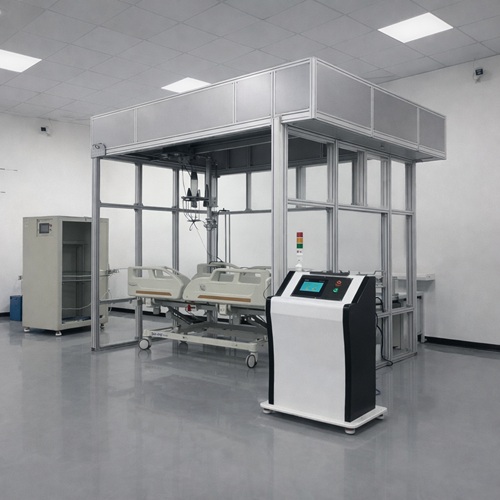
IEC 60601-2-52 addresses the basic safety and essential performance of medical beds intended for adults. A medical bed is a multi-component mechanical and electrical system that includes the frame, mattress support platform, side rails, lifting pole, castors, brakes, adjustment mechanisms and locking devices. A complete verification program therefore requires more than a general-purpose force tester.
Why medical-bed testing is mechanically complex
Loads are applied at different heights, directions and locations. Some tests are static, while others involve repeated cycling, impact or stability assessment. The fixture geometry, loading speed, holding time and bed configuration can change the result. The laboratory system must be rigid enough to avoid frame deflection while remaining adjustable for different bed sizes and structures.
Typical test modules
- Dynamic loading: repeated loading of the mattress platform or structural components;
- Static and compression loading: controlled force application with hold time and deformation observation;
- Impact testing: defined impact mass and drop arrangement for selected areas;
- Stability testing: loading at specified locations to evaluate tipping risk;
- Lifting-pole fatigue: repeated loading representative of normal and foreseeable use;
- Side-rail strength and locking reliability: multi-directional loads and functional inspection.
Mechanical system design
A high-stiffness test frame should allow the actuator and fixtures to move across the length, width and height of the bed. Servo-electric or pneumatic loading may be selected according to force, speed, travel and cycle requirements. Load cells measure force, while displacement or angle sensors can monitor structural movement. Multi-function systems need clearly separated test programs so operators can change from one test to another without rebuilding the control logic.
Safety and interlocks
Large moving beds and high-force actuators create significant hazards. The system should include mechanical travel limits, electrical limits, emergency stop, overload protection, fixture-retention checks and controlled restart after an interruption. The test area should provide enough space for bed movement, castor locking, fixture installation and safe operator access.
Traceable data and reporting
Useful records include sample identification, model, bed configuration, loading location, target force, speed, cycle count, peak values, displacement, alarms and operator information. Raw curves are valuable for engineering analysis, while a summarized report may be sufficient for routine production checks. Calibration and fixture-verification records should be linked to the test system.
Planning the right equipment configuration
Before purchasing equipment, list all current and planned bed models, maximum dimensions, maximum load, side-rail types, lifting-pole designs and adjustment ranges. A multi-function machine can save floor space, but only when fixture changeover, positioning accuracy and maintenance access remain practical. Some specialized clauses may still require separate fixtures or modules.
Related LSKFT equipment
See the Medical Bed Comprehensive Test Machine. LSKFT can also provide customized stability, side-rail, fatigue, impact and static-load modules according to the customer test plan.
Frequently asked questions
Can one machine perform every medical-bed test?
Many mechanical tests can be integrated, but the final scope depends on the applicable clauses, bed structure, force direction and fixture requirements.
Can an older bed tester be upgraded?
Often yes. The frame, actuator, sensors, fixtures, safety system and software should be reviewed against the current test program before an upgrade is defined.
LSKFT provides complete systems including structural design, custom fixtures, Siemens PLC control, precision sensors, data acquisition and acceptance support.