


Power Cord Flexing, Pull and Torsion Testing Guide for Appliance Safety Labs
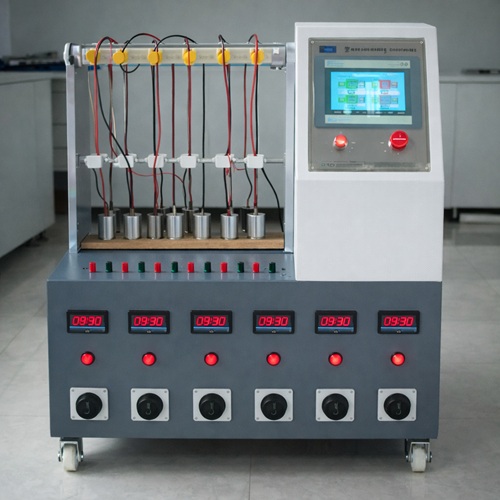
Power cords and internal wiring are common failure points in appliances, power tools, cleaning equipment and small electrical products. Repeated bending, pulling and twisting can damage conductors, insulation or strain relief structures. A well-designed test system helps manufacturers compare cord-entry designs, verify durability and maintain consistent quality-control procedures.
Typical test requirements
- Cord flexing or swing testing at a defined angle and frequency;
- Pull testing to verify strain relief and cord anchorage;
- Torsion testing for rotating or hand-held products;
- Continuity monitoring to stop the test when a conductor fails;
- Cycle counting, abnormal-stop recording and report export;
- Safety protection for energized samples when required.
Fixture design matters
The fixture must hold the sample securely without creating an artificial failure point. Adjustable bending radius, clamp position and cord alignment are important for repeatability. For laboratories that test many product types, quick-change fixtures reduce setup time and help operators use the correct configuration.
Control and monitoring
PLC or touch-screen control allows operators to set angle, speed, cycle count, dwell time and alarm conditions. Continuity monitoring should record the exact cycle at which the conductor opens. If the product is tested while energized, leakage protection, guards and interlocks should be included in the system design.
Using the data for product improvement
The result should not be limited to pass or fail. Useful reports include the failure location, conductor break type, insulation cracking, strain-relief movement and test cycle. Comparing several cord materials, grommet lengths and clamp structures can reveal which design improves long-term reliability.
Selection advice
Manufacturers with high production volume may prefer multi-station endurance testers. R&D laboratories may need a more flexible single-station system with wider angle and speed adjustment. LSKFT can configure both approaches depending on product range and test procedure.
Related LSKFT Equipment
Power Cord Flexing Test Machine, Power Cord Tensile and Torsion Test Machine, Power Cord Bending and Swing Test Machine