


How to Build a UAV Wind Resistance and Dynamic Wind-Field Test Laboratory
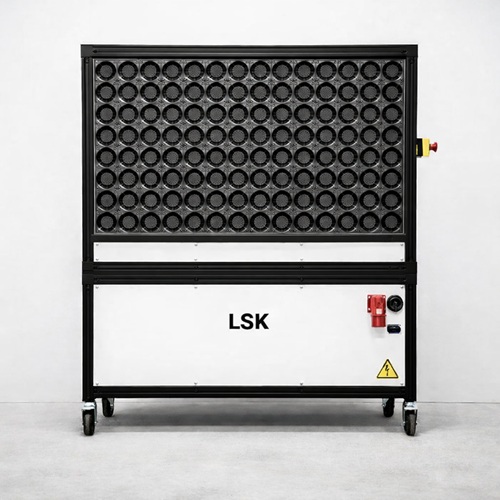
Outdoor flight trials are necessary, but they are not a reliable substitute for a controlled wind-resistance laboratory. Natural wind changes in speed, direction and turbulence from one test to another. This makes it difficult to compare flight-control algorithms, propulsion systems, payload configurations and structural changes. A properly designed UAV wind wall or airflow laboratory creates repeatable conditions for engineering development, verification and failure analysis.
Define the test objective before selecting the wind wall
The required system depends on what the laboratory needs to learn. A hover-stability study may need a large uniform test area and accurate low-speed control. A gust-response study needs fast fan response and programmable time profiles. A propulsion-margin study may require synchronized voltage, current, rotational speed and thrust data. The design should therefore begin with the largest UAV, target wind-speed range, test distance, payload conditions and acceptable turbulence level.
Key performance requirements
- Useful test section: large enough to cover the complete rotor envelope and expected vehicle movement.
- Wind-speed range: selected from the actual product operating envelope rather than an arbitrary maximum value.
- Uniformity and stability: verified at multiple points across the test plane.
- Dynamic control: programmable ramps, steps, gusts and zone-by-zone fan control when required.
- Repeatability: the same program should produce comparable wind conditions on different days.
- Safety: emergency stop, protective netting, flight boundary, interlocks and remote observation.
Typical system architecture
A modular UAV wind wall normally combines multiple fan modules, variable-frequency drives, an airflow-straightening section, multi-point air-velocity sensors, a control cabinet and supervisory software. Honeycomb or flow-conditioning structures can reduce swirl and large-scale non-uniformity. Independent fan zones can be used to create crosswind, asymmetric flow or localized disturbances.
Fan performance and airflow calibration may use engineering principles from standardized airway methods such as GB/T 1236 or ISO 5801. However, the UAV test layout, measurement points and acceptance criteria must be defined by the applicable customer specification, research protocol or product validation plan.
Recommended validation procedure
- Map the empty test section at several commanded wind speeds.
- Record baseline hover behavior without wind.
- Increase wind speed in controlled steps and monitor attitude, position and power margin.
- Apply programmed gusts or crosswind events and evaluate recovery behavior.
- Repeat critical conditions to quantify test variation.
- Document the UAV configuration, battery state, payload, software version and environmental conditions.
Instrumentation that adds real engineering value
Wind speed alone does not explain why a vehicle becomes unstable. Useful laboratories synchronize airflow data with vehicle attitude, position, motor speed, voltage, current, thrust or control-command information. High-speed video can help correlate physical motion with data events. A common time base is especially important when evaluating short gusts or control-system recovery.
Common design mistakes
One frequent mistake is placing the UAV too close to the fan array, where local jets and blade-related flow dominate. Another is oversizing the wind wall without checking the available electrical power, room height and noise limit. Laboratories should also leave enough distance for flow development, maintenance access and safe vehicle containment.
Related LSKFT equipment
See the UAV Wind Resistance Test Equipment, UAV Airflow Wind Tunnel Test System and UAV Power Tester.
Frequently asked questions
Is a wind wall the same as a closed wind tunnel?
No. An open modular wind wall is flexible and suitable for large test areas, while a closed or ducted wind tunnel offers a more constrained flow path. The better choice depends on vehicle size, wind speed, uniformity and research objective.
Can the wind program be customized?
Yes. LSKFT can configure wind-speed curves, zone control, duration, alarms, data sampling and test sequences according to the user test plan.
Shenzhen LSKFT Testing Instruments Co., Ltd. provides mechanical design, fan-array integration, controls, software, safety protection and on-site commissioning for customized UAV laboratories.